
“There are movies of destruction, and there are movies of repairing"
A conversation with Christian Petzold
From June 10 to 12, 2026, the Copenhagen-based film screening series Tusind sole, in collaboration with the cinemas Grand Teatret and Gloria, invited German filmmaker Christian Petzold to the city to present three of his own films, along with two films that have helped shape his identity as a director and cinephile.
The programme consisted of Miroirs No. 3 (Petzold, 2026), Phoenix (Petzold, 2014), Wolfsburg (Petzold, 2003), The Long Goodbye (Altman, 1973), and Notorious (Hitchcock, 1946).
Following the Danish premiere of his latest film, Miroirs No. 3, Petzold took part in a conversation with Tusind sole and the film’s audience. The conversation was recorded, and has now been transcribed. It can be read below.
by Tusind sole
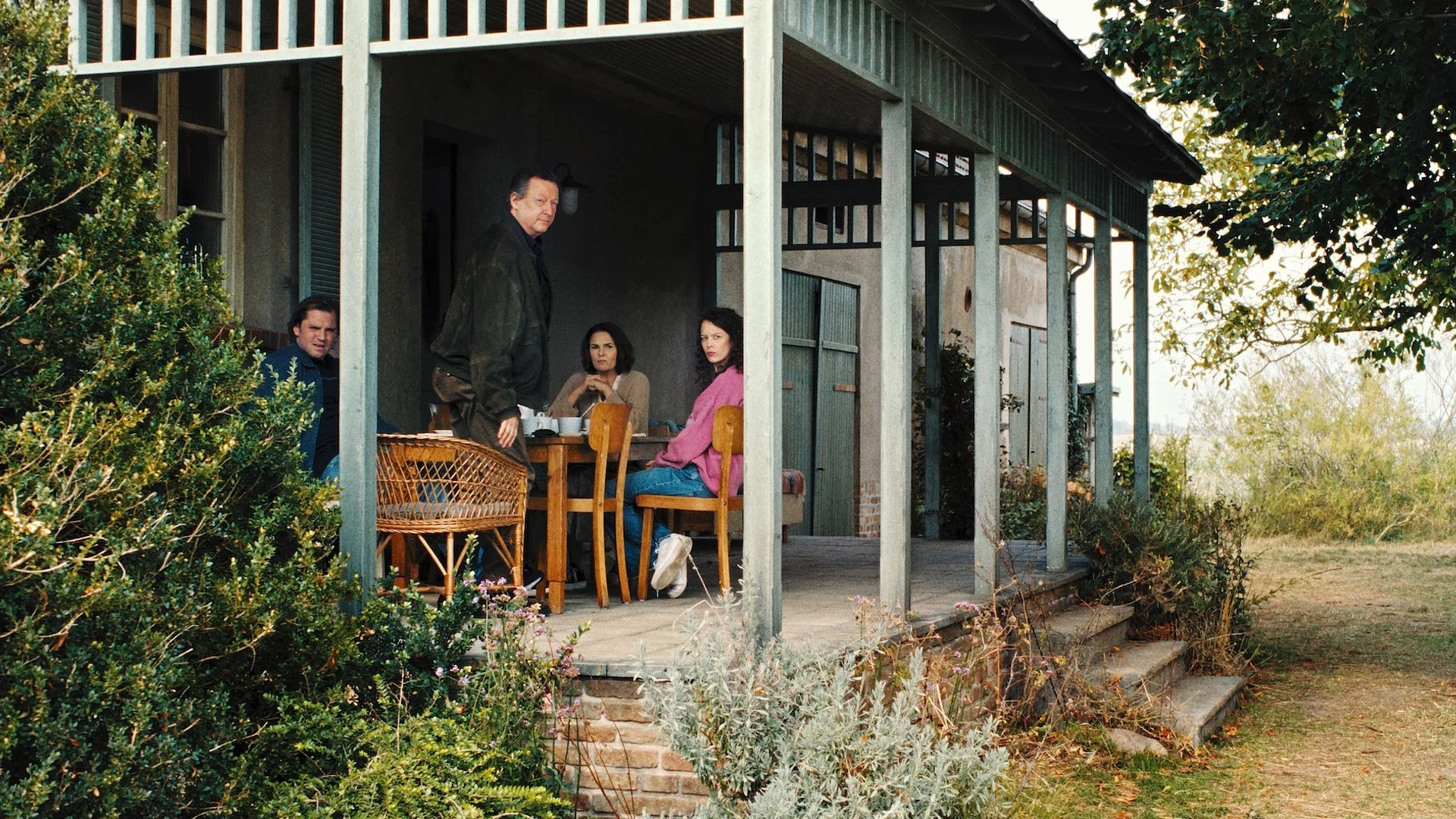
MIROIRS NO. 3
Christian Petzold, 2025
Tusind sole (TS): Thank you for the film, Christian. The films that get commercial distribution here in Denmark are not always the best films, but sometimes they are. And Miroirs No. 3 is a good example of this. And the fact that the films of Christian Petzold gets commercial distribution in Denmark is really something to be grateful for. So please tell all your friends that from tomorrow Miroirs No. 3 will be shown in Danish cinemas. Okay, enough plugging. As a start I would like to ask you a bit about the setting of the film. There are these fantastic settings and locations: the house, the gravel road, the garage, and a lot of things happen in between these three locations. Could you talk a bit about the specific area the film is filmed in and what drew you to this location?
Christian Petzold (CP): First of, I have to say that cinema is a little bit poor in German. All the movies you can see in television are over-dubbed, while in Denmark they are subtitled. Therefore the Danish people can speak English much better than the Germans. And I grew up with over-dubbed versions of American movies, so my English is poor, but I will give it my best.
Okay, to your question: So when the wall broke down in 1989, we in West Berlin could suddenly go into the East Germany – the German Democratic Republique – and the Uckermark area, where this film is shot is a part of the German Democratic Republique. And once my friend Harun Farocki and my wife and I took our bicycles and biked through the German Democratic Republique and discovered these small villages with American names. For instance, there was a small village with the name Philadelphia, and another one was called New Boston and names like that. So I asked myself where these names came from and discovered that in the 19th century the Germans had lost all their revolutions. All their revolutions were bloody defeats and in 1848 they lost another revolution, which made so many Germans want to leave Germany and go to the USA. But those who had to stay in Germany because of no money or family or other structures, they renamed their villages and gave them American names, because USA was their dream. So they named these villages: Villages of Broken Dreams, and this I liked very much. So I said that when I was going to make a movie in that area it had to be a western dealing with broken German dreams.
Is this an answer or a story? I don’t know, but when I was a child my parents had bought a house with the porch on the back of the house. And the same for all the other neighbours’ houses. And in my childhood it felt a bit like a jail for me. Because we had no contact to the street or the social life – I had to be in the backyard with my family, surrounded by fences and so on. But in the houses in these German villages with American names you find porches turned towards the street like in the USA, and this was interesting to me. So I told myself that I wanted to make a movie about a family with a porch towards the street. This was my first idea.
But I must confess that this house in the movie doesn’t exist and we built the porch ourselves. In reality this house is very ugly. But this part of Germany – Mecklenburg-Vorpommern – gave me money for this movie. €200.000. And in some interviews I have said that this is the ugliest part of Germany, there are only ugly houses and so on, so I will never receive money from this area again. But it is really, really ugly there, so we had to build up this house ourselves. Everything is made up. The fences, the porch, the windows, and also the room with the piano is built by us.
But something happened on the 20th day of shooting in the morning at nine o’clock. When I make movies, I always go to the shooting place by myself in the morning to think about what we are going to do this day and I imagine some things, before all the other guys come. It is a little bit like Franz Beckenbauer after he won the World Cup, where you see him standing there all alone. Okay, so I get there in the morning and see two old people – 80 years old – a man and a woman –standing inside the house, our location. First I thought: “We don’t have extras in our movies”, so I go and ask them, if I could help them with anything. And the woman replies: “We lived here in this house 40 years ago, and now it is so beautiful. But I remember that it was so ugly back then, and my childhood was so ugly too”, and then she started crying. And I said: “Why are you crying?”. And she said: “Because it doesn’t cost that much money to make an ugly thing beautiful”. This I remember.
But this house doesn’t exist anymore. There are people from Berlin who wants to go by bicycle to these shooting places, but they will never find this house.
TS: You touched a bit upon German history and the importance of that in your films. And I was wondering if you could talk a bit more about that, because the two other of your films we screen these next days, German history also plays a significant role. Phoenix (2014) takes place just after the Second World War. While Wolfsburg (2003) takes place in present day, but Wolfsburg is an important town when talking about German history, because this was the place where a lot of the military vehicles, missiles, planes were made during the Second World War. Could you talk about the importance of German history in your films and how you incorporate it?
CP: My children are radical left-winged and when we discuss I always loose, and when they were at the premiere of Miroirs No. 3 they came to me after the screening and said:
“It’s a good movie, but please make the next movie more political”.
So I said to them: “This is a political movie”.
“No”, they said, “Phoenix is a political movie, Wolfsburg is a political movie. But this is not a political movie”.
And then I said to my daughter, who is now 29-30 years old: “When you were four years old, I was home alone with you” – because her mother was in the hospital due to the pregnancy of our son – “And I was watching a football match”. I am always watching football matches, and when the family isn’t home, I watch horror movies. Really hardcore horror movies. And I remember I saw Hostel (2005) by Eli Roth, which is a very tough movie. And then my son, I think he was 17, crossed the living room where the tv-set was, and he stood there in his pyjamas and looked for 30 seconds and then he turned his eyes inside out and moved on, because it is very hardcore stuff.
Okay, but this time I was watching football, and then my four-year-old daughter came in and said: “Oh, my stomach hurts, I can’t sleep, can I stay here with you and watch a little bit of television?”.
" I am always telling stories. It is like with actors, when you start talking about psychology or traumas with actors, then that is the end of that day’s shooting. You must tell them stories and then they obey and will play well."
So, I switched the canal and there was a James Bond movie on, and I hate James Bond movies. But she said: “I want to see that”. So, I have her in my arms, and we watched James Bond. And the only thing I like in James Bond movies are the first five minutes with the intro and the music. But after ten minutes of watching this, she said to me: “I love James Bond”, which made me a little bit disappointed with my daughter, so I asked: “Why do you love James Bond?”. And she answered: “He can destroy everything and never has to clean up”.
And this for me was political, because when I made a movie with Hartmut Bitomsky, there was another guy from documentary filmmaking, Carlos Bustamante was his name, who said:
“Feature movies can destroy the world, while documentaries have to portrait the repairing of the world”.
And this is not a bad thought. And I think that my new movie Miroirs No. 3 is about repairing or cleaning up.
I also remember a quotation from Jean-Luc Godard who said: “There are two different kinds of movies, and you can name them with names of directors: Jean Renoir and Fritz Lang. Jean Renoir is coming from the dance to the idea. And Fritz Lang is coming from the idea to the dance”.
And perhaps you can also make a second quotation and say: “There are movies of destruction, and there are movies of repairing”.
And this is not a bad distinction, because sometimes society needs destruction to refresh. And for me nowadays – and this is also my answer to the question of political movies to my kids: I think we are living in a time where we need to repair something, and we have to portrait people who try to repair. This was my idea.
Was this a long answer and nothing said?
TS: No, it was a great answer. And maybe continuing a bit along this path, something that always amazes me in your films is the way they always feel very immediate and at the same time carefully constructed. For example, in this film there are these guys that come and pick up the cars and leave again, while there is all this life around and beyond the frame, which makes sense because of course there is life beyond the frame and film. And yet the way you work with editing, the way you work with your characters, you learn how to see, when you see these films. You learn how to see the building blocks of cinema and how these images and sounds work up like bricks and you form this house. I would like to ask how you think about this relationship between the world you encounter and the world you build through cinema?
[As he is about to answer the question, Christian Petzold’s microphone makes a loud and very unpleasant noise.]
CP: Sometimes when I am just about to lie, the microphone reveals me by giving of this sound, so maybe I should try another answer?
Okay, so, 20 years ago I made a movie named Ghosts (2005) and it was completely written. Everything in that movie was written. Everything was planned. And I planned everything, because I wanted to have time free during the shooting to do anything I wanted. So we had rehearsals in the morning for 2-3-4 hours without shooting – just to find some new spaces, some new rhythms, a new choreography, and then this thing happened: There is this scene in the movies, where the young actress Julia Hummer is in a casting scene and she has to tell a long, long story – three pages in the script – to a caster. She is to tell a lie with an essence of truth, and I had written down a really good story that I liked myself. She was 19 years old, and she came to me and said: “Three pages, oh my god, that’s a ten-minute-long monologue”. And I said to her: “You can do it however you want yourself, you can sing it, you can change it, you can do it in just three sentences if you want, it is yours to do with whatever you want”. So, I thought that in my films the actors are free.
And then on the day of shooting she came to me and she said: “I haven’t changed anything; I will do it precisely like you have written it down”. And when I asked her why and if she wanted to try and sing it also, she said “No, because she is not me, she’s an image, and therefore I have to find a relation to this protagonist. I am not part of the movie, I am a character or a persona, and persona means mask”.
I don’t know if this is an answer, but I think it is an answer. I am always telling stories. It is like with actors, when you start talking about psychology or traumas with actors, then that is the end of that day’s shooting. You must tell them stories and then they obey and will play well.
TS: That said, I think it is time that we ask you a question you can actually answer. Before the film, you talked about how your films have almost the exact same length as a football match. And you just mentioned you watch a lot of matches when the family is alone, and then you mentioned Franz Beckenbauer and I was just wondering if there is anything else in your filmmaking or how you approach your film that’s connected to football?
CP: When I was 10 years old there was a movie by Hellmuth Costard in German television. Costard was an experimental filmmaker in the 60s and 70s and the title was Fussball wie noch nie (1971), which translates to: Football as you have never seen before. And this movie was about George Best, who was a fantastic, famous player for Liverpool in the end of the 60s and in the beginning of the 70s. And this movie was made with six cameras with long telephoto lenses pointed toward George Best in a football match. You never see these typical camera angles that you know from watching matches in the television – you just see George Best, and you see someone who is very, very lonely, running and running, sometimes he has the ball for a second, and then he scores a goal, and they embrace and then, after 90 minutes, the movies is done. And for me this is a metaphor for life, because what you see in the movie is a lonely man, who is part of something, which is bigger and more than himself: a room, a space, a choreography, an idea. And I think that cinema has something to do with this part of football.
For 40 years I played football myself, but now both my knees are totally destroyed. But in March the Miroirs No. 3 team lost a football match in New York near the Hudson River to Alexandre Koberidze’s team from his film Dry Leaf (2025). They are from Georgia, they were very ambitious. We lost 3-2, and it is not a good memory for me. I couldn’t play due to my knees, so I was the coach, but the players from Georgia were big, and I am pretty sure they had used doping. But the feeling of space and connection to other people is something cinema and football have in common.
But in the history of cinema there are no good movies about football, because they have nothing to do with each other. For example there is a fantastic story named Foul Play by the Swedish crime story writers Sjöwall and Wahlöö about money and prostitution and betting in football. This is the only good thing you can create about football in cinema. The football match itself and cinema has almost nothing to do with each other.
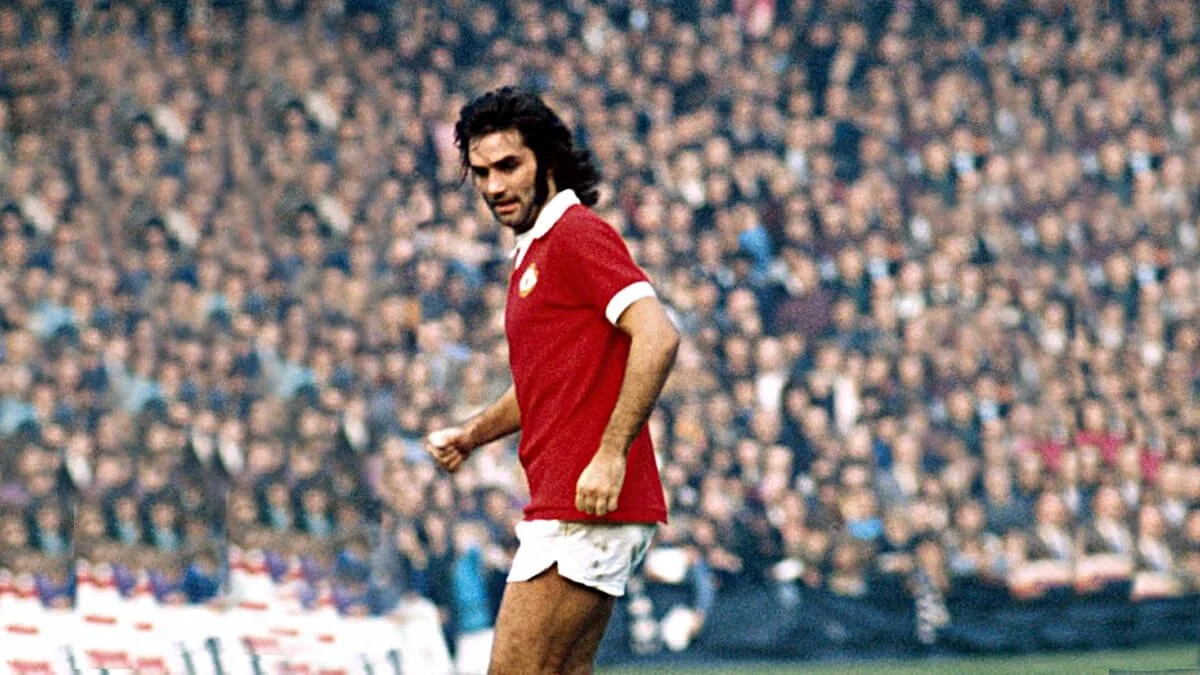
Fussball wie noch nie (Hellmuth Costard, 1971)
[One of the two moderators from Tusind sole takes off his shirt and flashes a green Borussia Mönchengladbach-shirt worn for the occasion, because this is the favourite team of Christian Petzold, who is now pointing towards the green jersey.]
CP: Borussia Mönchengladbach has been my favourite team since I was seven years old, and that also has something to do with Miroirs No. 3. I grew up in a really ugly city near Leverkusen called Wupperthal, Düsseldorf. It is also in a very ugly part of Germany, and the town Mönchengladbach is a very, very ugly town. There are many ugly towns in Germany, but this town is really, really, really ugly. 180.000-200.000 people live there, and they are not ugly all of them, but the town is ugly. But in the 1970s this team from this ugly town played very modern and very beautiful football, which gave me the idea as a kid, that if we can enchant our ugliness and play beautiful and fantastic football, then perhaps we can also make fantastic movies.
Another example is the band Kraftwerk that came from Düsseldorf, which is also very close to the place I grew up. In September last year I was at their concert in Berlin and it was beautiful. They found the beauty in the neon light in the night of the city. This is very romantic, and this I like. And with this team Borussia Mönchengladbach it is a reminder that you can find a way out of the ugliness that surrounds you, which is why I love them so much. And for the last 30 years I have used the names of the players to name my characters.
TS: That was a good connection between football and cinema. There is a cinematographer for American baseball games who is a big cinephile and frames it like John Fords frames it – you can see it online. Let’s talk about Paula Beers character, Laura, she…
CP: Paula Beer is an intelligent actress, I must say. This is our fourth movie together, and I love her because she doesn’t need me. After she has made a scene, she leaves and goes to be by herself, and she doesn’t have the need to hear: “Oh that was great”. She hates this. She was never in an acting school. When we made our first movie together, Transit (2018) in Marseille, I spoke to her for one and a half hour about Hitchcock, why I love Hitchcock so much and about some sequences in his films. And the next day there was an Amazon car in front of the hotel with the entire work of Alfred Hitchcock on DVD, because she had ordered it. This I like. For me this is acting school. I sent the script for Miroirs No. 3 to Paula Beer and Enno Trebs, the male actor in the film. I was very proud of the script, I must say, and for two or three days I walked through Berlin like someone who had won the main prize in a tombola. Then I received a call from Paula Beer who asked me if we could talk. This was the first time she had received one of my scripts and hadn’t written me a supporting message like: “The script is great, fantastic, I would love to work on it”. No, this time she said: “We have to talk”, and I hate that. That is something you do in love couples: “We have to talk” means separation. But then she and Enno came to my office, and they asked me about the script. They wanted to know something about the script, because they had difficulties with it. In the script I had written down a final scene where she plays in the university at the end, and then the family comes back to the house and sits on the porch and eats eggs and drinks coffee, like they still do in the movie. But then Laura is standing there with a black coat and a suitcase, and then – in that script – she opens the fence and I had written this sentence:
“She opens the gate and enters the room of the family”.
This was my final sentence. And when I wrote it down, I had goosebumps, which made me believe I was the best author ever. So in my office Paula said to me: “I don’t understand why she is coming back to the family as a daughter. It doesn’t make any sense”. And I answered: “No, this is the best final sentence I ever wrote in my life, and I don’t want to hear any more criticism”.
Then we get to the shooting. It is going well and there is a good atmosphere. We are shooting chronologically, so we have to shoot the final scene with the fence and the black coat and the suitcase as the last one. During that shot I am standing on the porch behind the family and watching Paula opening the fence, and in that moment, I knew everything was wrong. That what I had written was totally shit. I was thinking to myself: “What kind of ending is this? You go back to the family? What is happening to me?”. I was so confused with myself and started questioning my desire: “Is my desire to live in a family?”. But I didn’t let it show in my face at that moment.
Then we came to the editing and the editing table and Bettina Böhler, who edited the film said: “It’s bullshit. The end is bullshit”.
This was in November. And November in Berlin is a tough time, it is a suicidal time. And when you have a depression, because you have made a really big mistake, you are very close to suicide. So I walked through Berlin and thought and thought and then the editor and I got the idea to open it again with the scene in her apartment, where she is coming back to her apartment. And we used the exact same cadrage, the same material, the same fence, but a small thing had changed, and this small thing was the whole world.
"No, it is not a third part of a trilogy. And this trilogy lie – I must stop with this shit."
I told them a story about Antonioni’s L’avventura (1960). In this film someone is vanishing and before the vanishing you see Monica Vitti and a guy walking through a small village and people are staring at them, because Monica Vitti is blonde and it is an Italian movie, so the young people go completely out of their minds. After the vanishing she goes back to the same village, and something has changed. Antonioni used the same extras on the streets and the stairs to show the small differences instead of the big. And this was also our idea.
The hardest thing was to phone Paula Beer and say that we would shoot the final scene again. Before the telephone call I had written down what to say to explain, but she was very cool and clear and said: “When? January? Perfect”. This was five months after the shooting had ended and then she says: “But there is one problem. I am pregnant. Eight months in”. So she was in her third month of pregnancy, while we shot the film, and I had no clue. But I said: “No problem, because the cadrage will not show the stomach”.
But she never said to me: “I told you so” about the ending. And I like this very much. So we started shooting again and it was fantastic. Because she was pregnant in the eight month, so she was a completely different woman, her skin was different, and you can see it a little bit in the end, that she is in doubt, and that is a fantastic final picture of someone, who wants to be a daughter, but then in the end she learn to be in doubt. That’s a movie and not this thing I wrote down and told myself was the best final sentence I had ever written.
TS: I was wondering if you could talk a bit about the importance of the car crash in your film. There is one Miroirs No. 3. There is also one in Wolfsburg, which we will see tomorrow. But what’s the cinematic fascination of the car crash about for you?
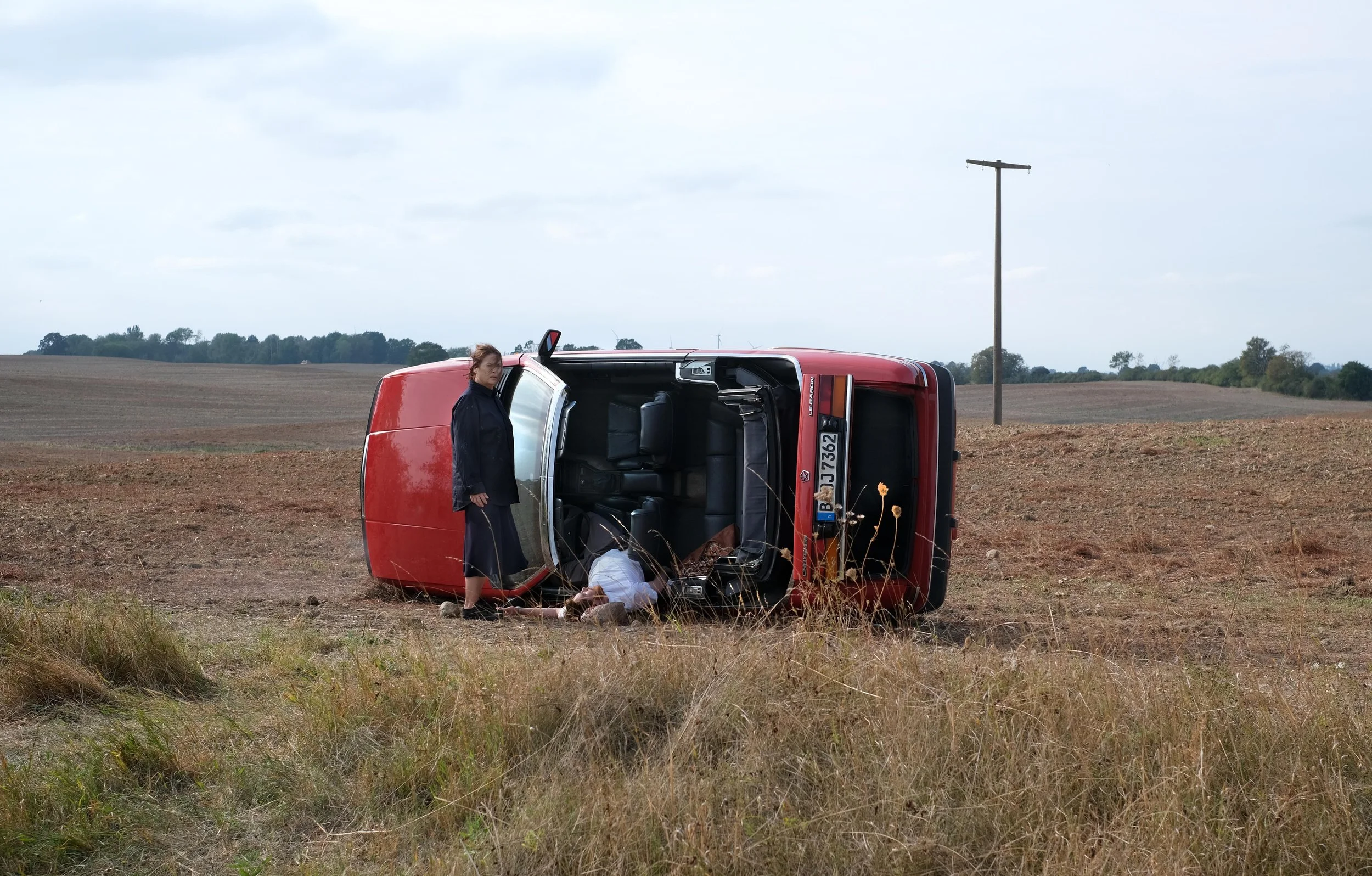
CP: It has something to do with Germany and cars. When it comes to the Germans and their cars, they are crazy. In Germany you can start a story, when someone is out of gasoline or when they are in a car crash. Then something happens. When they are just sitting in their car, driving, they are boring. So you need a car crash in Germany to start a story and movie. This was one of the ideas I had. But I actually don’t like car crashes in movies. There are people that are professionals in making car crashes for cinema. And when I am working with actors like Paula Beer or Nina Hoss or someone, we have a good chemistry and atmosphere. We talk about culture and so on. But then these car crash guys arrive, and everything changes. They have tattoos everywhere, they are tough, they are like men in Western movies, and all the actors get the feeling that these men are people who really work. Unlike actors who just play doctors and can’t do anything, they can’t help you if your car breaks down.
Actors don’t know anything, they pretend they do, their job is to pretend. Then these car crash guys come, these specialists, and they really work, which makes the actors feel guilty that they can’t do anything, and then the actors don’t want to talk with me anymore, they want to talk with these tough, tattooed guys. And I always say that real car crashes or car accidents are never like in the movies, the cars don’t make somersaults in the air. I showed the car crash guys a movie by Hou Hsiao-hsien called Goodbye South, Goodbye (1996), where it is just a car that drives into a tree, and they said: “This is boring – You can do this shit by yourself”. But I like this kind of car crash. So in this movie, Miroirs No. 3, I said, I wanted a car crash, you don’t see. Because I remembered that I haven’t seen a car crash in my entire life. But three or four times I have heard a car crash. It is always like this: I am on my bicycle, and I hear the sound of the wheels screeching and the airbags exploding and the collision and then I turn around and see that someone have driven his car into a wall or something. But you never see a car crash, you hear it. And that was the idea for this movie; you hear a car crash, and then you see what happens after. So, these are the car crashes of the future for me. I will never again make a car crash with those tattooed guys.
TS: The Hou Hsiao-hsien film will be screened in Copenhagen in October, if anyone is interested in seeing that one. Okay, is there anyone from the audience who wants to ask a question?
Audience (AU): Now you talked about the ending of the film, but what about the beginning of the film – what does that mean?
CP: At the bridge? Okay, well actually I had made another opening scene in the university, where she is playing piano, but has a panic attack just before the students arrive. But I didn’t go with that one.
During the screening, while you were watching the film, I was sitting outside and I had a coffee and a toast and I was watching people go by. Next to us there was a restaurant, and I saw a guy from the restaurant park his car and the car had photos of steaks on it. And there was a woman who went around the car, watching it like she had never seen a steak before. So I had some thoughts about this woman. And I wanted to open a movie like this: You see someone and you don’t know who it is or what she is doing there, so you get curious and you have to produce thoughts yourself.
In Miroirs No. 3 you see a young woman on a bridge, cars are passing by and she is standing in front of a canal. There is this guy in black who is passing like in the romantic painting The Island of Death by Arnold Böcklin. You see the young woman from the other side and she has fallen to the ground, but what is she doing? It is a suicidal scene, yes, but it is also a scene which is a little bit like in a tale. Paula Beer is – like I said – really intelligent and sometimes this is a pain in the ass, and she asked me why I had cut out some of the other things we had made for the opening, and I said that this scene was not an introduction of her character. So I said to her:
“Alice in Wonderland! You don’t know anything about Alice, nothing, you don’t know where she lives, where she grew up, how old she is. The only thing you know is that she is there, there’s a rabbit, there's a rabbit hole, and then the story starts”.
And the story is her life; the story is her biography and character. Therefore the movie starts like this.
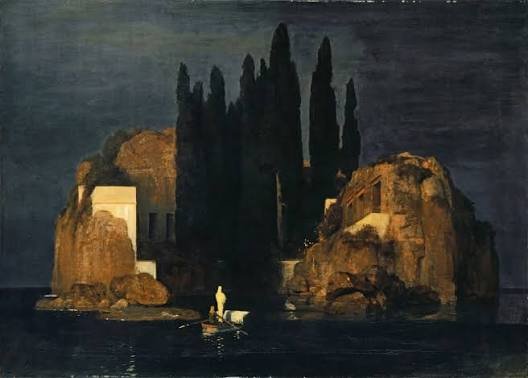
Dødens ø (Arnold Böcklin, 1880)
AU: Near the end you kind of change the perspective from Laura to the family and I am just curious on your thoughts about that and how that came about?
CP: The first moment we change the perspective is the moment before the car accident. She is passing the house for the first time and there is the exchange of glances between them. But the second time we stay with the mother – Betty – so in that moment she becomes part of the story, and she has a perspective too. But this is interesting, because we must think about it. Like in music, when you compose something; two or three wrong notes can destroy everything. So we must be very, very sensible with this other woman, how she comes into the story and has her own perspective. And I need this, because at the end of the film, you have to ask yourself: Why did the daughter commit suicide? It has something to do with the mother, she is like a Hitchcock monster mother, she is always grabbing. There is a piano, there are books, this daughter had to be the best in school, the mother was always waiting for her, you can feel this. And so, she had to learn to let the second daughter go. This is one of the story lines.
AU: Thank you so much for the film and the discussion. I really appreciate what you said about the destructive film and the films that repair, and I really think it says a lot about your approach. My question is: After you made Undine (2020) and Afire (2023), you said that you wanted to make a trilogy about the elements: water, fire, earth and air. But my impression is that this film – Miroirs No. 3 – is not the third film of this trilogy. So, I am curious, are you still planning on making another elemental movie?
CP: Okay, now I must tell the truth again. Again and again. My best friend Harun Farocki, who passed away ten years ago, and I, we both have a Protestant education. And the Protestants are really, really poor people, because for instance the Catholics, they can commit the hardest sins and then they do one confession and can go on with their bad things and weird sexual habits and so on. But the Protestants must work and work and work, and when they are lazy it is a sin, so the Protestants must always work. And so, Harun said: “When we have made a great movie, which we like and has found an audience, then we, as Protestants, we can’t lay down and relax for one year, no, we have to work immediately again, as if we should and must be punished for making something good”. And so he said: “The only thing we can do, when we have made a good movie, is to say that this is just the first movie of a trilogy. Then we can work on as Protestants”.
So, after I made Die innere Sicherheit in 2000 I said that this is the beginning of a trilogy about ghosts. And after I made Undine I said that this is the beginning of a trilogy about the elements. It was lucky that in the second movie Afire, there was fire. So, I have two of the three. But in this movie I have no idea. I have said that this is the third part of a trilogy, but I don’t know what part it is.
But actually, on the tenth-fifteenth day of shooting Miroirs No. 3, we filmed this night scene where Betty – played by Barbara Auer – is outside the house and Laura is watching her, and there was a really strong wind made only by nature. And afterwards Barbara Auer said: “Perhaps wind is the element in this one”. So we call it: “Perhaps wind”.
But no, it is not a third part of a trilogy. And this trilogy lie – I must stop with this shit.
AU: Thank you very much for a beautiful film. There is something about the use of technology and modern technology in your films that surprises me every time it enters the film. In this one it is every time this brand new lavish BMW car comes and in Jerichow (2008) there is a mobile phone ringing. And I get this weird sense that on one side it doesn’t belong here, but on the other it really does belong there, and that takes me into the reality of the time the film was made.
CP: I made a film called Transit, which is a movie where the story takes place in 1941 in Marseille, but we made it contemporary in our days. So the past was in the present or our present was in the past, this was the thing. And I was thinking: Which technologies can I then show in the movie? And my son, who has this name: Computer Dennis. Really. Everybody in Berlin knows him as Computer Dennis, he knows everything about computers. So I asked him: “What kind of modern technologies can I use in a movie that is both in the past and in the present at the same time?”. And he said: “No cell phones, no cd-players”. A telephone is not a problem, but a cell phone is, because we have so many advertisements from Apple for example: Iphone 11, Iphone 12. 200 idiots waiting in front of an Apple store to be the first to have an Iphone 12 or 17. So anyone who will notice an Iphone 16 in the film will say: “Oh, this is a very old movie”. But when you see someone going into a telephone box, you will not say the same thing. So, he said, that the technologies I could use were: vinyl records – you can always use vinyl records because you can see something is moving, spinning and then music comes out. A display of a cd-player for example is shit on film and a cell phone display with Spotify on is total shit.
It's the same as with costumes in movies. Three weeks ago I saw a really bad movie called Basic Instinct (1992) for the first time. It was really bad. It’s the one with Michael Douglas and no trousers on – that scene where everybody is starring, but there is nothing there to see. In this film they have the ugliest costumes I have ever seen in my life. The women all have these big shoulder pads, and Michael Douglas’ trousers are horrible and they are wearing these goofy loafers. It is really bad, because they wanted to be contemporary. But if you see La Femme d’à côté (1981) by Francois Truffaut, you see that the shirt of Depardieu is classic. And for movies you need classic things.
I hate when characters are sending a text message or a WhatsApp message in new movies and you see the text on screen. I am sure that in two years you will never see this in a movie again. We are not interested in technologies, we are interested in the things that happen between people through technologies.
There is this one fantastic thing on YouTube – my son, Computer Dennis, showed me – it is three nerds on a couch talking about CGI in movies. They are watching two movies: Dune (1984) by David Lynch and the new Dune (2021) with Timothée Chalamat, which is made completely with CGI. In the beginning they laugh at David Lynch’s film, which is made in a time with no computer things, so they build everything – like the animator Ray Harryhausen. But after a few minutes of discussion they get the feeling that the hand-made David Lynch-movie is much more intense than the very expensive CGI thing. And they ask themselves why, and the answer is that it is because it doesn’t look so fantastic and clean. They are much more impressed because they can see the work people put into it. With a vinyl, you see it, you see the work the musician or composer made, it is there on the turntable. On Spotify, you don’t see the work. You just see modern day exploitation.
AU: I have a pretty unrelated question and properly also a silly one, but it is to debunk a myth I might have propagated around me. I was living in Berlin 2022 and one of my neighbours in the building was called Petzold. And since then I have been saying to my friends that my neighbour was Christian Petzold, the director. So, I just wanted to ask, if you by any chance lived in Prenzlauerberg back in 2022?
CP: No, I am sorry, this must be another Petzold. I live in Kreuzberg (Petzold actually revealed his full address at the conversation, but for privacy concerns we have left that out). And nearby there used to be a ballet dancer with the name Petzold. And sometimes the postman brought me the letters from this ballet dancer, and he was homosexual and received some fantastic love letters. And because I thought it was for me, I sometimes opened them, and there was some really dirty stuff in them. This is the only other Petzold I know from Berlin. I used to close the letters again and bring them back to him and put them in his letterbox. I never met him back then, but two-three years later I met him and he said; “I sometimes received letters from you as well and I put them in your letterbox”. So we have a connection. But your Petzold must be another Petzold.